

How to Create a Content Bank for Your Bookkeeping Business
One of the hardest parts of staying visible isn’t writing the content. It’s deciding what to talk about.
You sit down to write a LinkedIn post or client email, and suddenly can’t think of a single useful thing to say. Meanwhile, during the rest of your week, ideas are everywhere.
- A client asks a question you’ve answered dozens of times
- You send a reminder that would probably be useful to every client
- You explain why something matters
- You notice the same misunderstanding again
The ideas aren’t really the problem. The problem is that they’re rarely waiting for you when you sit down to create content. That’s where a content bank can help.
What is a content bank?
A content bank is simply an organized collection of topics you could write about. It doesn’t have to contain finished posts. In fact, most of the ideas can be a sentence or even a few words.
The goal is to give yourself somewhere to look when you need something to write about.
Instead of asking: What should I write about today?
you can ask: Which idea from my content bank should I use today?
That’s a much easier question to answer.
Start with the questions your clients ask
Client questions are one of the easiest places to find useful content. Consider what someone has recently asked you.
- Why do I need to send this?
- When do you need my documents?
- What does this report tell me?
- Why doesn’t the amount in my bank account match my profit?
- What should I keep?
If one client has wondered about something, there’s a good chance another has too. Add those questions to your content bank. You don’t have to answer them yet. You’re simply collecting possibilities.
Add the things you explain repeatedly
Some ideas don’t arrive as questions. They’re the things you find yourself explaining again and again.
- Explanations of why documents need to arrive on time
- Reminders of why keeping business and personal transactions separate makes things easier
- Something clients often misunderstand about what their bookkeeping software does automatically
Every repeated explanation can become a piece of content.
Add useful reminders
Not every piece of content needs to teach something new. Sometimes, the best thing to do is remind someone of what they already know. Think about the reminders you naturally give clients throughout the year.
- Documents to gather
- Information to update
- Deadlines to remember
- Questions to ask
- Things worth reviewing before year-end
Add those to your bank too. Some will be useful anytime. Others can sit there until the right month comes around.
Add what you wish more clients knew
Here’s another useful question: What do I wish my clients understood before they started working with me?
- How you communicate
- Why you need certain information
- What good bookkeeping actually helps a business owner do
These topics can show potential clients the value of your work. They also help current clients collaborate with you more efficiently.
Give your ideas a few simple categories
Once you’ve collected some ideas, organize them enough to make them useful. You might use categories such as:
Client Questions: Questions clients and potential clients regularly ask
Tips & Explanations: Things you often teach or explain
Client Reminders: Helpful prompts you can use in emails or social posts
Common Misunderstandings: Things business owners often get wrong or find confusing
Seasonal Topics: Ideas that make sense at a particular time of year
You don’t need an elaborate filing system. The purpose is to make ideas easier to find, not create another system you have to maintain.
Your Content Idea Catcher and Content Bank can work together
If you’ve already downloaded the Content Idea Catcher, keep using it. That’s where you can quickly capture an idea when it appears.
Your Content Bank is what comes next.
Every so often, take the useful ideas you’ve collected and move them into your bank. Give each one a category and add a note about how you could use it. One idea might become a LinkedIn post. Another could become a client email. A bigger question might become a blog post.
You don’t need to decide immediately. You’re simply building yourself a supply of possibilities.
Build your first bank in 20 minutes
You don’t need 100 ideas before your Content Bank becomes useful.
- Set a timer for 20 minutes
- Reflect on recent chats with clients
- Think about the questions you’ve answered
- Remember the reminders you’ve sent
- Include what you wish more business owners understood.
Write down whatever comes to mind. Even 10 or 15 ideas give you something you didn’t have before: a place to start. And the next time you sit down to create content, you won’t have to begin with a blank page.
Build your own Content Bank
I’ve created a simple Content Bank template in Google Sheets that you can save and use online. Write down ideas as they come. Group them by category. Keep your notes or draft handy for easy access.
You might be wondering…
How many ideas should I keep in my content bank? There’s no magic number. Start with 10 or 15 useful ideas. Your bank will grow as you see more questions, reminders, and topics in your daily work.
Do the ideas have to become social media posts? No. An idea can turn into a social post, blog article, client email, newsletter topic, or even a chat with a client.
How often should I update my content bank? You don’t need another weekly task. Capture ideas as they appear and spend a few minutes organizing them when your list starts to grow.
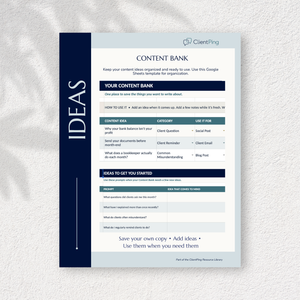
Content Bank
Stop starting from scratch every time you need something to post. Use this worksheet to organize your content ideas and build a collection you can turn to whenever you need inspiration.
Get Your Free Ping Starter Kit
Includes a blog post, client email, social posts, and a Quick Start Guide.
More to explore
-
A Simple Mid-Year Communication Check-In for Bookkeepers
It’s easy for communication to slip during busy seasons. This mid-year check-in will help you take stock of how visible you’ve been, reconnect with clients and prospects, and choose a simple communication habit you can maintain.
-
A Simple, Consistent Way to Stay in Touch with Your Clients
Staying connected with your clients doesn’t have to feel like extra work. A simple, consistent approach makes it easier to stay in touch without overthinking it.
-
Why Showing Up Regularly Builds Trust with Your Clients
Trust isn’t built through one big moment, but through showing up over time. Regular visibility helps your clients feel more familiar and confident in working with you.


